Dear Colleagues and Friends,
We are pleased to announce the release of Topics V and VI in our ongoing English video series, “How to Read Chinese Poetry.” To date, this series is quickly approaching one million views with just 13 episodes. We extend our sincere gratitude to our viewers for their sustained interest and scholarly engagement.
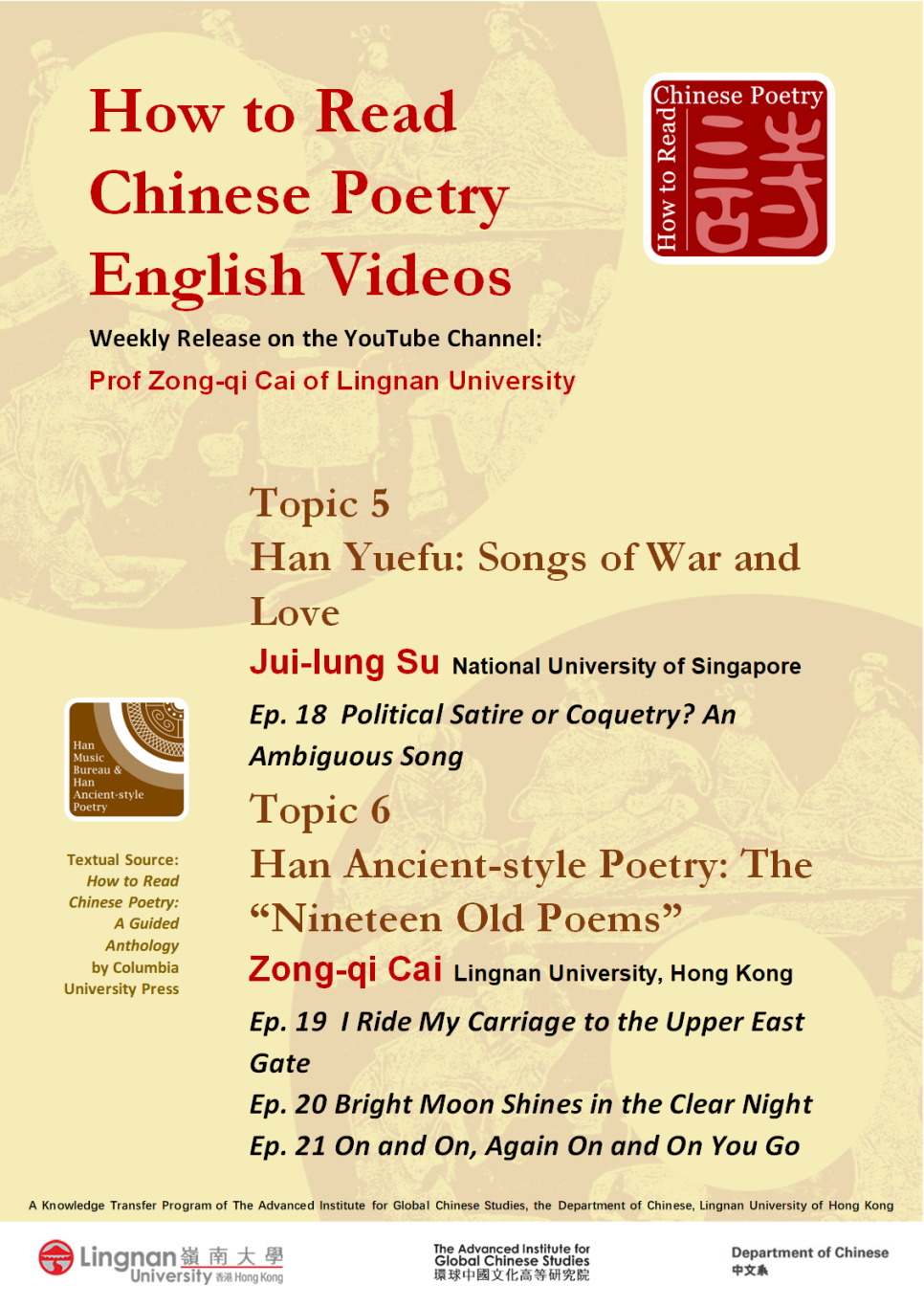
Topic V: Han Yuefu: Songs of War and Love
In this topic, Professor Jui-lung Su of National University of Singapore discusses the two opposing interpretations of the poem “Mulberry Along the Lane”: either as a representation of social injustice, or as a witty, playful exchange between a man and a woman.
Episode 18: Political Satire or Coquetry? An Ambiguous Song
Topic VI: Han Ancient-style Poetry: The “Nineteen Old Poems”
After nearly a millennium since its birth, Chinese poetry achieved an optimal convergence of sound and sense in the pentasyllabic poems developed during the Eastern Han dynasty (25–220 CE). Episode 19 explains how the magic of a single additional character led to the rise of reflective poetry on human transience, with a rhythm far more expressive than any that had existed before. Episode 20 examines how two formal features—binary structure and multilateral texture, as developed in the “Nineteen Old Poems”—correlate with the shift from oral performance to poetic writing, and from the dramatic/narrative mode to the lyrical mode of self-presentation. The final episode discusses the first poem in the collection, which is also its best-known work about an abandoned woman, highlighting its mosaic-like fusion of time, space, and emotional fragments that together capture an otherwise inexpressible melancholy.
Episode 19: I Ride My Carriage to the Upper East Gate
Episode 20: Bright Moon Shines in the Clear Night
Episode 21: On and On, Again On and On You Go
Please enjoy the show, and feel free to share your thoughts! Wishing you a very happy Chinese New Year!
Zong-qi Cai
Program Host